
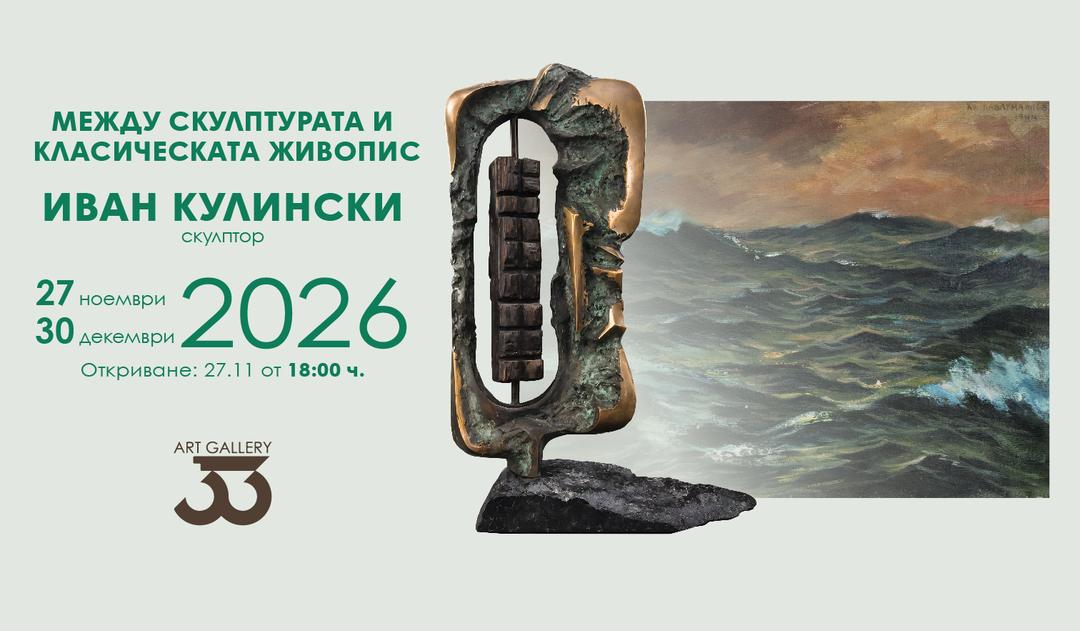
It is a pleasure for Gallery 33 to present a curated selection of sculptures by Ivan Kulinski, an artist who, in recent years, has established himself as one of the most prominent and promising figures of his generation within Bulgaria’s contemporary art scene. While he works primarily in the realm of small-scale sculpture, he is also active in the field of outdoor sculpture, where he has created several highly distinctive, intriguing, and memorable works.
The sculptor focuses on the concept of the singular—sometimes multi-part, yet always compact—work. Most of his pieces eschew narrative; however, there are instances where the artist alludes to imagery and situations drawn from the past or from cultural memory—such as Don Quixote. As a rule, Kulinski avoids elaborate, complex, or multi-figure compositions. Instead, he strives for the purity of a sign, emphasizing the decisiveness and formal conviction of the silhouette. This is clearly a deeply considered creative credo. At the same time, he achieves this without sacrificing any of the natural richness or beauty of the original material. This is precisely why his sculptures resonate with the viewer in such a compelling and unforced manner. The compositional, sculptural, and spatial approach—whether applied to a human figure, an animal, or an object—preserves that essential "intrigue" which compels us to engage with the work with keen interest. It unfolds through the dynamic interplay of transitions and a rich web of associative links between the figurative and the abstract. The artist strives to extract the full potential from the aesthetic and artistic qualities of metal: the intersection of volumes, the richness of texture, the luster, and the nuanced subtleties of form.
Ivan Kulinski works with consistency, professionalism, and enviable energy in a field that is as complex and challenging as it is rewarding—a domain in which he successfully reveals the full depth of his artistic talent.
Prof. Chavdar Popov
The collection of Gallery 33 comprises over 100 paintings by artists belonging to the classical tradition of Bulgarian painting. This exhibition features a selection of more than 20 works by Konstantin Shtarkelov, Boris Denev, Alexander Mutafov, Hristo Kavarnaliev, Georgi Velchev, Mario Zhekov, Ivan Trichkov, Atanas Mihov, and Nikola Tanev.
These are works by established figures in Bulgarian fine art, whose contributions highlight the richness and diversity of the Bulgarian landscape during the first half of the 20th century—an era when nature became not merely a subject for artistic depiction, but also an expression of personal experience. This selection of paintings showcases the richness of Bulgarian landscape art—ranging from lyrical watercolors and an impressionistic sense of light to dense oil paintings and seascapes.
Konstantin Shtarkelov is one of Bulgaria’s greatest watercolorists. Known as the "King of Watercolors," he remains one of the most recognizable figures in Bulgarian landscape painting. He studied under Ivan Mrkvička. Having served as a military artist, he went on to establish his own school; he exerted a profound influence on the development of Bulgarian watercolor painting and inspired many followers.
Boris Denev stands out as a remarkably interesting and versatile figure in Bulgarian visual arts. Born in Veliko Tarnovo, he ranks among the significant Bulgarian landscape painters of the first half of the 20th century. He created over 2,000 landscapes of Veliko Tarnovo—his hometown served as a vast source of inspiration, and he dedicated a large portion of his body of work to its streets, houses, and architecture.
His works are valuable not only as paintings but also as historical records of Bulgaria’s past appearance.
Alexander Mutafov is considered the founder of the marine genre in Bulgarian art. He devoted much of his creative output to the sea—capturing its elemental power, its light, and its ever-changing moods. He studied painting in Munich, where he became acquainted with European artistic trends. In 1937, he received a silver medal at the World’s Fair in Paris for his painting *The Blue Boat*. This is one of the most significant recognitions of his career. That same year, he built his own studio in Sozopol. Today, this studio is connected to the Alexander Mutafov House-Museum.
Hristo Kavarnaliev
A student of prominent Bulgarian artists, he studied at the School of Industrial Arts under Ivan Mrkvička, Anton Mitov, Jaroslav Věšín, and Ivan Angelov. An exceptional marine painter, he depicted the open sea, storms, fishing boats, harbors, and rocky coastlines. In 1926, he held an exhibition of graphic works at the Tretyakov Gallery in Moscow. His pieces attracted interest and were acquired for the gallery’s collection. He held 45 solo exhibitions, with displays in Bulgaria, Berlin, Paris, and Moscow.
In this exhibition, Gallery 33 presents the painting "Old Varna." It is a work of historical value, depicting the city of Varna as it appeared in 1750.
Georgi Velchev is among the most significant innovators in Bulgarian painting during the 1920s. He studied under Ivan Mrkvička and Stefan Ivanov. In 1924, he left for New York, where he remained until 1931. He traveled throughout the United States, Canada, and the Hawaiian Islands, organizing eight solo exhibitions. His work reflects influences from Impressionism, Post-Impressionism, and Symbolism; he did not adhere to academic realism.
Mario Zhekov
He studied at a drawing school in Paris, where he became acquainted with European art movements—most notably Fauvism and the work of Henri Matisse. Throughout his life, he traveled and painted; places such as Istanbul, Paris, Nice, Monaco, Dubrovnik, Sozopol, Nesebar, Balchik, and Varna served as sources of inspiration. He preferred to paint directly in nature rather than in a studio. His 1934 exhibition in Sofia was met with great enthusiasm, establishing him as one of Bulgaria’s leading marine painters.
Ivan Trichkov
He is remembered in the history of Bulgarian painting for his mountain landscapes, which prominently feature the beauty of the Rila and Pirin ranges, as well as other mountains in his homeland. His work is characterized by precise draftsmanship, rich colors, and delicate half-tones. Tsar Boris III was an admirer of his art and owned several of his paintings.
Atanas Mihov was one of the major Bulgarian landscape painters of the first half of the 20th century. He was born in Stara Zagora. His work is characterized by lyrical realism and an impressionistic sensibility. A student of Mrkvička and Jaroslav Věšín, he graduated from the State School of Drawing in 1904—a fact that places him among the first generation of professionally trained Bulgarian artists. He possessed a vivid connection to nature and is considered a founder of the modern Bulgarian landscape genre.
Nikola Tanev is one of the most beloved and highly regarded Bulgarian artists of the 20th century. He is often called the "painter of sunshine," a title inspired by his exceptional depictions of Karlovo—works imbued with light, warmth, and vibrant color. He studied in Paris, attending the Paris Academy of Decorative Arts from 1908 to 1912. In 1910, he visited the studio of the great French Impressionist Claude Monet in Giverny. Throughout his career, he held dozens of solo exhibitions across Bulgaria and Europe.
In this dialogue between heritage and modernity, the exhibition expands the concept of the artistic image beyond the confines of painting. The inclusion of sculpture introduces an additional dimension: the presence of form within space, along with its inherent materiality and corporeality.
Opening: November 27, 2026, 6:00 PM
Exhibition dates: November 27 – December 30, 2026
Venue: Gallery 33, 2A Gabrovo St., Varna
Tel.: 0899878333
Admission: Free