
FOCAL POINTS
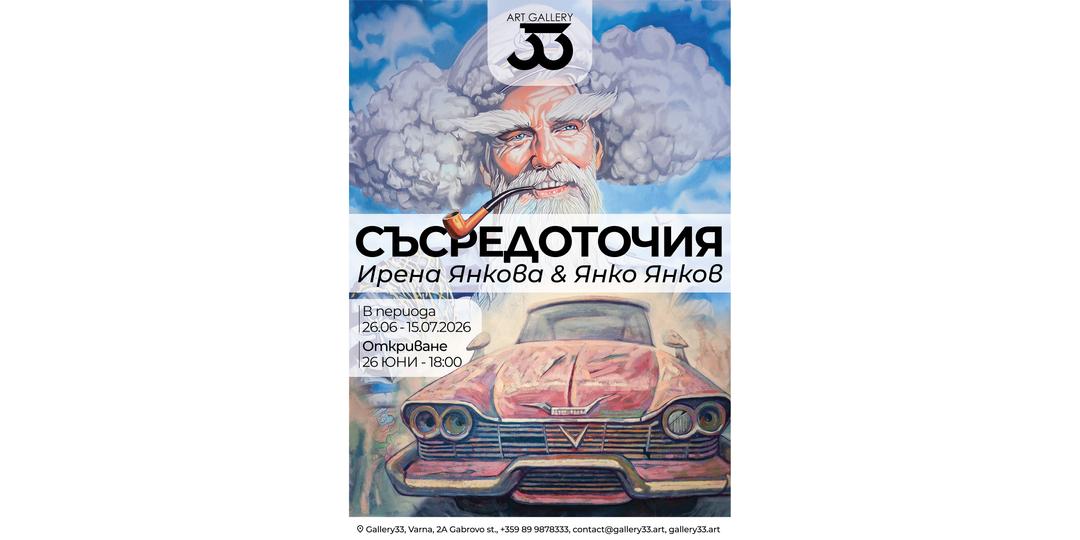
On June 26 at 6:00 PM, Gallery 33 is pleased to present a joint painting exhibition by artists Irena Yankova and Yanko Yankov.
The official opening and introduction of the artists will be conducted by Professor Radoslav Radev.
The exhibition features works exploring a wide range of themes and artistic expressions, from figurative compositions to abstract creations.
What unites these works is a shared interest in humanity and human experience, our connection with nature, and those small and significant aspects of life that we cherish, preserve, and that bring us a sense of happiness and meaning.
The paintings offer diverse perspectives and moods through which to view the world. Some are contemplative and poetic, while others are vibrant and full of energy and color. Yet all have been created with the intention of touching the viewer and inspiring a personal emotional response or reflection. Every visitor may discover within them something that resonates with their own experiences, memories, or dreams.
The exhibition presents artworks suitable for a variety of spaces and aesthetic preferences. Among them are several pieces that would make wonderful focal points in children's interiors: however, the exhibition as a whole is intended for a broad audience and encompasses a diverse range of themes and artistic explorations.
We warmly invite you to join us for the opening on June 26 at 6:00 PM at Gallery 33, 2A Gabrovo Street, Varna.
We are looking forward to sharing this artistic experience with you and hearing your impressions.
Admission: Free
CONCENTRATIONS
Paintings Exhibition by Irena Yankova and Yanko Yankov
In Bulgarian fine art, there are quite a few artist couples with remarkable achievements. Today’s exhibition presents Irena Yankova and Yanko Yankov. Through the apt title "Concentrations", they convey the idea of their infinite differences alongside their incredible proximity in the pursuit of harmony. For them, ideas stem from composition, which acts as the conductor of a colorful orchestra—ready to empower abstract resonance with intoxicating freedom and extreme realism with unadulterated purity. They represent a search for a beginning in days when we constantly think about the end. Irena Yankova is a precise draftsman with an intuitive sense of composition that makes the painting feel like a living organism. At the same time, she delves into detail much like sunlight enters the leaves of a tree—stepping in as the master walking through their own garden. Thus, she follows nature, for there is no brush more magical for transformation than light.
What is striking in her paintings is the reconciliation between man and nature. Nature does not judge; it simply takes what it needs. Nothing is foreign to it because if man is the synthesis, nature has provided the spectrum—an immortal spectrum that feeds the senses rather than the mind.
Irena Yankova’s paintings amaze with their color vibrancy and unexpected crimson perceptions. A instantaneousness of colorfulness is born, allowing things to be themselves, calmed in time. This aesthetic enables the viewer to enter the canvas with a clean mind and heart, never wishing to leave. Wandering through a painting as an act of perception is a Renaissance idea, but with Irena Yankova, it becomes a new attempt for man to save himself from himself through the emotion of affection and wonder.
It is no coincidence that she seeks the imagery of the butterfly—which modern research shows to be a master of mimicry through the dynamic eye spots on its wings. Mimicry in nature is an essential necessity; humans follow it too, though nowadays it serves more as a pose or fashion. Yankova's attempt to return us to natural colorfulness restores our faith in the eyes, which are the windows to the soul.
Hence, she is not drawn to the typical, but to the whimsical. She opens the world of childhood, embraces the magic of The Little Prince, and sees in the nude body the true clothing of man beyond the illusions of civilization. When light enters the human body, we do not ask where the cosmos is—we simply communicate with it. For the artist Yanko Yankov, nothing in painting is impossible. Yet today, the world deserves to be painted not merely because it exists, but because someone needs to warm it with love. This is how colors come alive in his works—as a feeling meant to turn form into magic, and composition into a sanctuary for human consciousness.
His abstract harmonies offer an escape from the formulas and equations through which we sustain our rationalism. They give us reason to see a spring where our soul has dried up. The abstract in Yankov’s work represents freedom of association and warmth of mood, allowing the viewer to forgo searching for arguments and realize they can be unburdened in their perceptions. The direction merely triggers the sense of a journey—reason enough for one to experience meaning like a bird in flight.
The artist's sensitivity gradually releases the color blue, seeking the multi-layered meaning of green as a synthesis that holds the eyes of all hues. It is precisely green that reminds him we must slow down the speed with which we glorify ourselves today and embrace contemplation instead.
It was the Futurist artists at the beginning of the 20th century who heralded the arrival of "eternal, omnipresent speed," and it is fitting for an artist to apply the brakes to this intoxication—for, as Paul Valéry wrote, along the way we forget thought and delight.
The automobiles in Yankov’s work—highlighted by the larger format of his canvases—have stopped forever. Their technological forms have acquired an anthropological resonance. Nature has endowed them with silence: a silence that is not a harbinger of storms, but of purification. And that purification happens in green.
These are not abandoned or obsolete machines; they have asked nature to shelter them, for in nature, nothing is ever useless. The very titles of the paintings—"Another Form of Existence", "Another Dimension of Life"- demonstrate that human creations can be perceived beyond the concept of utility. I believe this should apply to humans as well! Beyond utility, we remain who we truly are. This intertwining of aesthetics and philosophy accelerates the pulse of the exhibition. The title itself, "Concentrations", is a call from Irena and Yanko Yankov to live in the moment—to realize that the familiar is merely the surface, beneath which lies our true manifestation.
Unfamiliar within the familiar - this is the joyful paradox that only art can grant us.
Prof. Radoslav Radev